

Modern Dairy Responsible AI Management Policy
1. Introduction
Modern Dairy actively promotes the application of artificial intelligence (“AI”), the Internet of Things (“IoT”), big data and other digital technologies across areas such as smart farming, dairy cow health monitoring, precision feeding, disease early warning, raw milk quality management and supply chain services. We recognize that, while AI can improve operational efficiency, animal health and sustainability performance, it may also give rise to risks relating to data privacy, information security, algorithmic bias, model reliability and inappropriate use.
To regulate the development, procurement, deployment and use of AI, Modern Dairy has established a responsible AI management mechanism to promote the safe, compliant, fair, transparent, controllable and sustainable use of AI technologies.
2. Scope
This Policy applies to Modern Dairy Group and its subsidiaries, as well as employees, contractors, suppliers and other business partners involved in the development, procurement, deployment, operation or use of AI systems. It covers AI models, systems, platforms and related services developed internally or procured or used from third parties. This Policy has been reviewed and approved by the Executive Management of the Group.
3. Commitments
We commit to:
- Respect data privacy: Comply with applicable data protection and personal information protection laws and regulations throughout the AI system lifecycle and follow the principles of lawfulness, fairness, necessity and data minimization. Personal information, trade secrets and other sensitive data must not be used to train AI models or entered into unauthorized external AI tools without appropriate authorization.
- Protect the cybersecurity of AI systems: Incorporate AI systems into the Company’s information security management system and implement identity authentication, access controls, data encryption, log monitoring, vulnerability scanning, security testing and incident response measures to prevent unauthorized access, data leakage, attacks on AI models and other cybersecurity risks.
- Prevent bias and unfair outcomes: Assess the quality, representativeness and potential biases of training data in applicable use cases and regularly review AI system outputs to prevent unreasonable, unfair or discriminatory impacts on employees, customers, suppliers and other relevant parties.
- Maintain human oversight: AI shall be used only as a supporting tool in decisions concerning food safety, raw milk quality, animal health and welfare, employee rights or the material interests of customers or suppliers. AI systems must not make irreversible or high-risk decisions without effective human oversight. Authorized personnel have the authority and ability to review, intervene in, override or suspend AI-generated outputs and the operation of AI systems.
- Ensure transparency and explainability: Clearly define and communicate the intended purpose, scope, key capabilities, data sources, limitations and potential risks of AI systems. External-facing AI-generated content, important recommendations generated by AI and outcomes of AI-assisted decisions shall be appropriately labeled. Understandable explanations shall be provided to affected parties where reasonably practicable.
- Establish clear accountability: Assign responsible business functions, technical management functions and human reviewers for each AI system, with clear accountability for system operation, risk assessments, decision reviews and corrective actions. Errors, inappropriate outcomes or harm associated with AI systems shall be promptly investigated and remediated.
- Define clear boundaries for AI use: AI systems may only operate within their approved business scope and intended purposes. Employees are prohibited from deploying unauthorized AI tools, extending the use of AI systems beyond their approved purposes or circumventing security controls. Appropriate approval, testing and human review requirements shall be established according to the risk level of each AI system.
- Reduce the ecological footprint of AI: When procuring, developing and using AI models and cloud computing services, consider the energy consumption, water use and carbon emissions associated with AI models and data centers. Give preference to technology and service providers that demonstrate higher energy efficiency, actively use renewable energy and provide relevant environmental information. Reduce unnecessary use of computing resources through model optimization and appropriate allocation of computing capacity.
- Prohibit inappropriate uses: We will not develop or deploy AI systems that use manipulative or deceptive techniques to materially distort individual behavior; exploit vulnerabilities associated with age, disability or socioeconomic circumstances; engage in social scoring; or conduct biometric surveillance without a lawful basis and appropriate authorization. AI must not be used for any illegal, discriminatory or clearly unethical purpose.
4. Responsible AI Programs and Practices
4.1 AI System Registration and Access Controls
We maintain a register of AI systems and tools deployed by the Company, recording their intended purposes, responsible functions, data types, technology or service providers, scope of application and risk levels. Access to systems involving facial recognition, video surveillance, biometric identification or other sensitive capabilities is restricted to authorized personnel and approved purposes. Such systems are subject to least-privilege access, identity authentication, activity logging and regular access reviews.
4.2 Disclosure of AI Use and Labeling
Where AI-enabled interactive functions are provided to employees, customers, suppliers or other external parties, we proactively disclose that they are interacting with an AI system. External-facing text, images and other content generated by AI, as well as outcomes of AI-assisted decisions that may have a material impact on relevant parties, are clearly and appropriately labeled. Necessary records of content generation and human review are retained.
4.3 Model Monitoring, Bias Assessments and Corrective Actions
Based on the intended purpose and risk level of each AI system, we continuously or periodically monitor model accuracy, false-positive rates, false-negative rates, changes in underlying data and operational stability to detect model drift or performance degradation. Where a model’s performance falls below defined standards, the Company takes appropriate corrective measures, including data validation, parameter adjustment, model retraining, version rollback, additional human review or suspension of the system.
For AI systems that may affect individual rights or interests, we regularly conduct fairness and potential bias assessments. For business models used in dairy cow health monitoring, oestrus detection and disease early warning, we assess data representativeness and the consistency of model performance across factors such as farm location, dairy cow breed, parity and stage of lactation.
4.4 Human Review and Appeals Process
Employees, customers, suppliers and other parties affected by AI-generated outputs may request an explanation, human review or correction through the Company’s existing business contact channels or information technology service channels. We register and investigate such requests, arrange for personnel with appropriate responsibilities and professional capabilities to conduct a human review, and communicate the outcome in a timely manner. Where necessary, the Company may withdraw or amend a decision made with the assistance of AI.
4.5 Employee Training
We provide responsible AI training to employees involved in the development, procurement, management and use of AI systems. The training covers data privacy, information security, algorithmic bias, human oversight, review of AI-generated content, boundaries for AI use and incident reporting requirements. When a new AI system is deployed or a material change is made to an existing function, the Company provides targeted training to relevant employees and assesses training effectiveness through tests, case studies or simulation exercises.
4.6 Supplier Management and Environmental Impact Controls
As part of the procurement of AI systems and services, we assess suppliers’ capabilities in data security, privacy protection, model reliability, incident response and environmental management and incorporate relevant requirements into contracts or other agreements. While meeting business requirements, the Company seeks to reduce energy consumption by selecting efficient models, appropriately allocating computing resources and minimizing repeated training and idle computing capacity. We also encourage technology suppliers to provide information on the energy consumption, water use and carbon emissions of their data centers.
4.7 Digital Farm Management System and Sustainability Outcomes
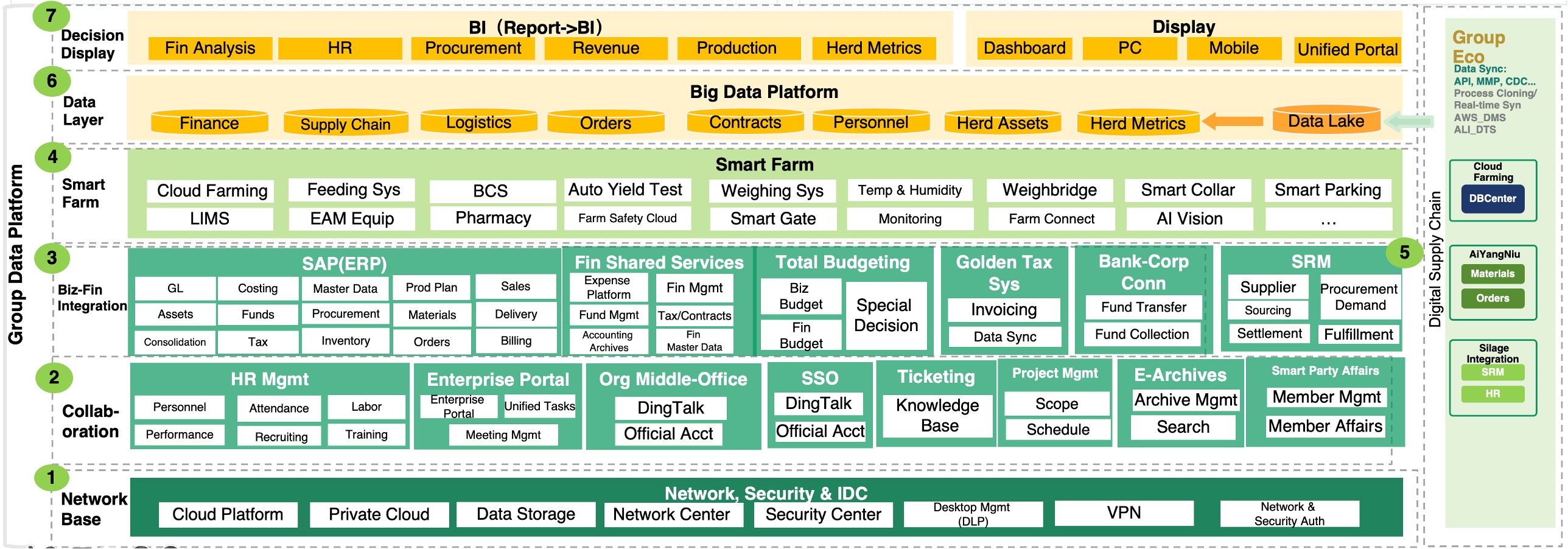
The Company has established a digital management system covering network and information security infrastructure, management collaboration, integrated business and finance operations, smart farms, big data platforms, and business decision analytics. As shown in Figure 1, the Company’s digital management system is supported by foundational capabilities including cloud platforms, data storage, and network and security management. It connects business systems relating to human resources, the enterprise portal, SAP (ERP), shared financial services, comprehensive budgeting, supplier relationship management, and smart farm operations. Relevant business data are consolidated through the big data platform and data lake to support financial, human resources, procurement, revenue, production, herd, and key performance indicator analyses.
The smart farm system includes Yunyangniu, feeding systems, body condition scoring, automated milk yield measurement, weighing systems, temperature and humidity monitoring, milking parlour management, smart collars, AI-enabled image recognition, and other production management applications. Following appropriate access controls, quality checks, and data governance, relevant data may be used for business analysis, risk alerts, anomaly data detection, and management decision support. AI and big data analytics results are presented to authorized personnel through approved BI reports, management dashboards, desktop applications, or mobile applications and are subject to appropriate access controls and activity logging.
As of 30 June 2026, the Group had cumulatively deployed approximately 260,000 smart wearable devices, covering nearly 90% of its adult dairy cows and supporting the continuous monitoring of herd health and production status. The Group had also integrated 11 core business systems spanning 13 business departments and launched 67 automated reports. According to the Company’s internal estimates, these automated reports collectively save approximately 8.5 person-days of manual data collation and report preparation each day, further improving data processing and operational management efficiency.
These digital, automated, and AI applications collectively support the Company in improving data quality, production efficiency, and animal health management. The Company will continue to enhance the performance indicators for its AI initiatives, track the impacts of AI applications on resource efficiency, greenhouse gas emissions, animal health and welfare, production efficiency, and employees’ ways of working, and quantify relevant outcomes where reliable data and reasonable measurement methodologies are available.
4.8 AI-Assisted Anomaly Data Detection and Business Analysis
The Company uses AI-assisted anomaly data detection capabilities in approved areas such as finance, human resources, procurement, revenue, production, herd analysis, and key performance indicator analysis, supported by its big data platform and business intelligence (“BI”) analytics tools. These tools may combine business rules, historical trends, statistical analysis, and machine learning models to analyze relationships among relevant indicators and assist in identifying unusual fluctuations, missing data, duplicate records, values outside reasonable ranges, logical inconsistencies, cross-system data discrepancies, and material deviations from historical trends. Identified anomalies may be presented to authorized personnel through BI reports, management dashboards, desktop applications, or mobile applications as risk alerts to support data quality management, business analysis, and management decision-making.
AI-generated anomaly alerts are used only as indicators for further investigation and do not necessarily mean that the relevant data are incorrect or that an actual business anomaly has occurred. The responsible business function shall conduct a human review by considering the data source, statistical methodology, business context, and actual operational circumstances. No irreversible or high-risk decision concerning financial processing, production and operations, food safety, raw milk quality and release, animal health and welfare, employee rights and interests, supplier settlement, or other material interests may be made solely on the basis of an AI-generated anomaly alert. Without appropriate authorization, the relevant tools must not automatically delete, overwrite, or modify original business data.
Based on the applicable business scenario and risk level, the Company registers anomaly detection tools and manages their data scope, detection rules, indicator thresholds, rule or model versions, and access permissions. Necessary records of anomaly alerts, human reviews, and actions taken are retained. Based on the relevant risk level, the Company periodically evaluates the detection accuracy, false-positive rate, false-negative rate, and operational stability of these tools. Where changes in data definitions, the business environment, or historical patterns result in performance degradation or anomaly alerts that consistently deviate from actual business conditions, the Company may take measures including data validation, adjustment of rules or parameters, model optimization, version rollback, additional human review, or suspension of the relevant function.
AI-assisted anomaly data detection tools shall also comply with the requirements of this Policy relating to data privacy, information security, human oversight, accountability, boundaries for AI use, and supplier management.
5. Oversight, Review and Continuous Improvement
The Company incorporates responsible AI management into its information security, risk management and internal control systems and regularly reviews the implementation and effectiveness of relevant management measures. The Company reviews this Policy and its related management mechanisms at least annually. The Policy and related controls will also be updated in a timely manner following material changes in applicable laws and regulations, the technological environment, business applications or AI-related risks.